

Ingredients
- 0 flour (wholemeal: always mix with normal flour so as not to alter the leavening)
- Water (based on the weight of the flour, add 70% water at room temperature)
- 3 g of dehydrated brewer’s yeast per 1 kg of flour (6 g of fresh yeast)
- 20 g of salt per 1 kg of flour
- 20 ml of extra virgin olive oil
- Half a teaspoon of sugar
Preparation
Pour the flour into a large bowl. Put the dehydrated yeast into a glass with two fingers of warm water and a teaspoon of sugar. Mix and leave it for a minute until a foamy mixture forms. If using fresh yeast, dissolve it directly in the container holding the water required for the dough.
Add the water to the flour in two or three stages, mixing with a spoon. The dough will be coarse and sticky. Cover the container with cling film or a plate and leave it for about 20 minutes.
Once the time has passed, place a spoonful of extra virgin olive oil on the work surface and spread it with your hand to prevent sticking. Grease your hands as well.
This method prevents adding too much flour to the work surface, which could be absorbed by the dough and alter its proportions and balance.
Folding
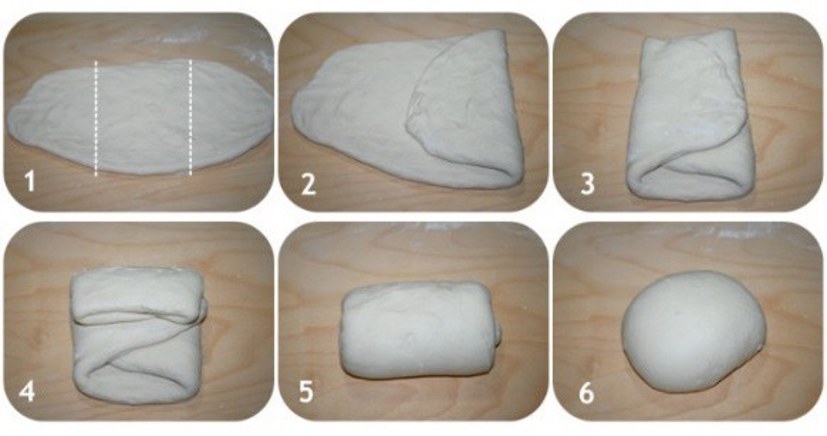
Roll the dough into a rectangle (photo 1) and make the folds shown in photos 2, 3, 4, and 5. Repeat the operation three times, leaving the dough to rest for 20 minutes between each round.
Finally, shape the dough by tightening it well. Cup it with your hands, pressing the lower part towards the center to ensure there are no holes through which air can pass.
Drizzle oil into a sufficiently large and tall container. Place the dough inside, cover with cling film, and leave it to rise at room temperature for at least one hour.
The Cold Chain
Once the initial rising time has passed, place the container on the lowest shelf of the refrigerator for approximately 20 hours.
This rising method is called the “COLD CHAIN.” It allows the dough to rise very slowly using very little yeast, resulting in a light, airy, highly porous, and digestible product.
The original recipe notes that feeling very thirsty after eating pizza or focaccia may indicate that too much yeast was used for a quick rise.
Depending on when you plan to prepare the pizza or focaccia, remove the dough from the refrigerator at least three hours beforehand. Keep it covered and allow it to rest at room temperature for at least one hour.
The Staglio (Dividing the Dough)
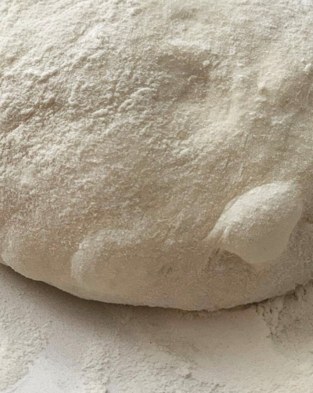
Place the dough on the work surface and divide it into portions according to the size of the product you want to make.
For a home baking tray measuring 30 × 20 cm, calculate the dough weight as follows:
30 × 20 × 0.6 = 360 g of dough.
Weigh the dough portions using a scale and divide them with a pastry cutter, taking care not to tear the dough. Shape the portions into balls and seal them well as described in the previous step.
Leave them to rise for another three or four hours, or until doubled in volume.
Rolling Out
Grease the baking tray. Gently stretch the dough with your fingers, working from the center outwards without dragging it. Apply light pressure with your fingertips to avoid breaking the bubbles that form.
The Focaccia Seasoning
Prepare an emulsion using equal parts room-temperature water and extra virgin olive oil, along with a spoonful of salt. Whisk vigorously with a fork until thoroughly combined and cloudy in appearance.
Pour it evenly over the dough. Gently press your fingertips into the dough to create dimples, allowing the seasoning to penetrate.
Garnish with rosemary sprigs, fennel seeds, or other ingredients to taste. Other excellent options include previously stewed onions, gorgonzola, and walnuts.
The Pizza Seasoning
The main ingredients are tomato, mozzarella, basil, and a drizzle of extra virgin olive oil added at the end of cooking.
Cut the mozzarella and leave it in a colander to drain excess liquid, which could otherwise make the dough wet during cooking.
For best results, cook the pizza initially with only tomato and salt. Add the mozzarella during the second stage of cooking to prevent it from becoming too dark.